




The special political dependence of the special prosecutorial trio
The High Court in Podgorica’s decision to return the indictment filed by the Special State Prosecutor’s Office against Aleksandar Mijajlović and five other defendants for revision is the ultimate proof of the brutal political instrumentalisation of the prosecutorial trio. At the same time, it has laid bare a disturbing truth: there is a direct correlation between the political moves of those in power and the actions of the Special State Prosecutor’s Office. The pattern is unmistakable: whoever is targeted by the leaders of the post-August government soon becomes the subject of investigation by the Special Prosecutor’s Office.

„The judge accuses you, and the judge passes sentence on you...“ (Original: „Kadija te tuži, kadija ti i sudi...“)
That old Serbian proverb dates back to the Ottoman era, when the „kadija“ was the sole authority in a village - acting both as prosecutor and judge.
Several centuries later, not in Serbia but just the other day here in Montenegro, in the High Court building in Podgorica, we witnessed a remake of that old saying.
„The prosecutor accuses you, and the prosecutor will sentence you as well...“
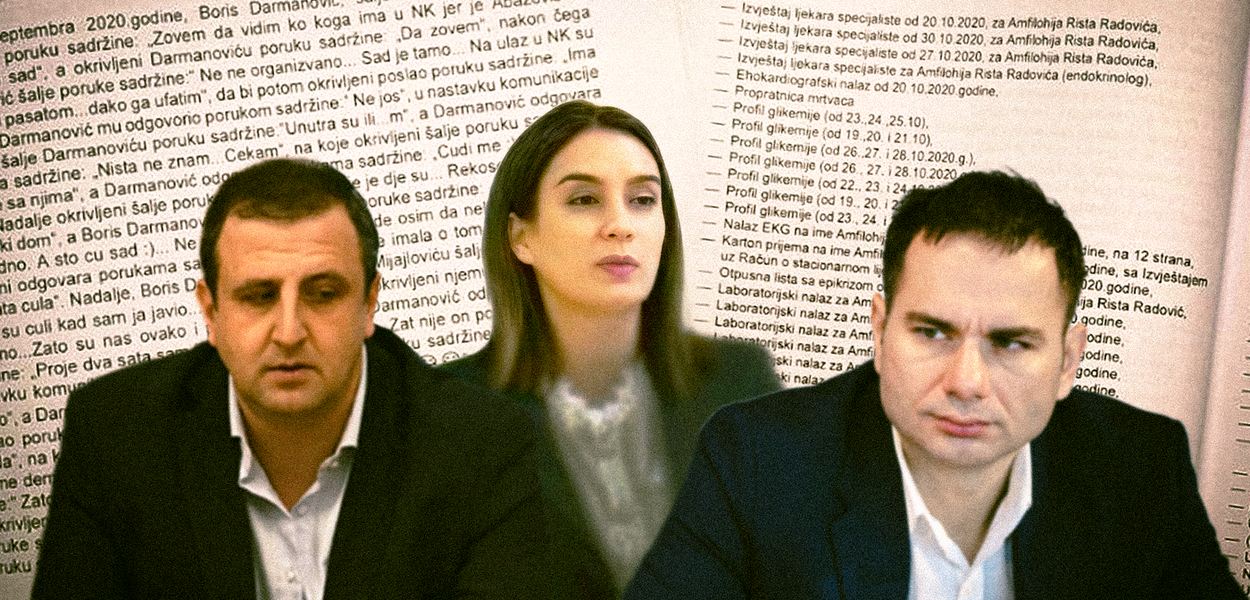
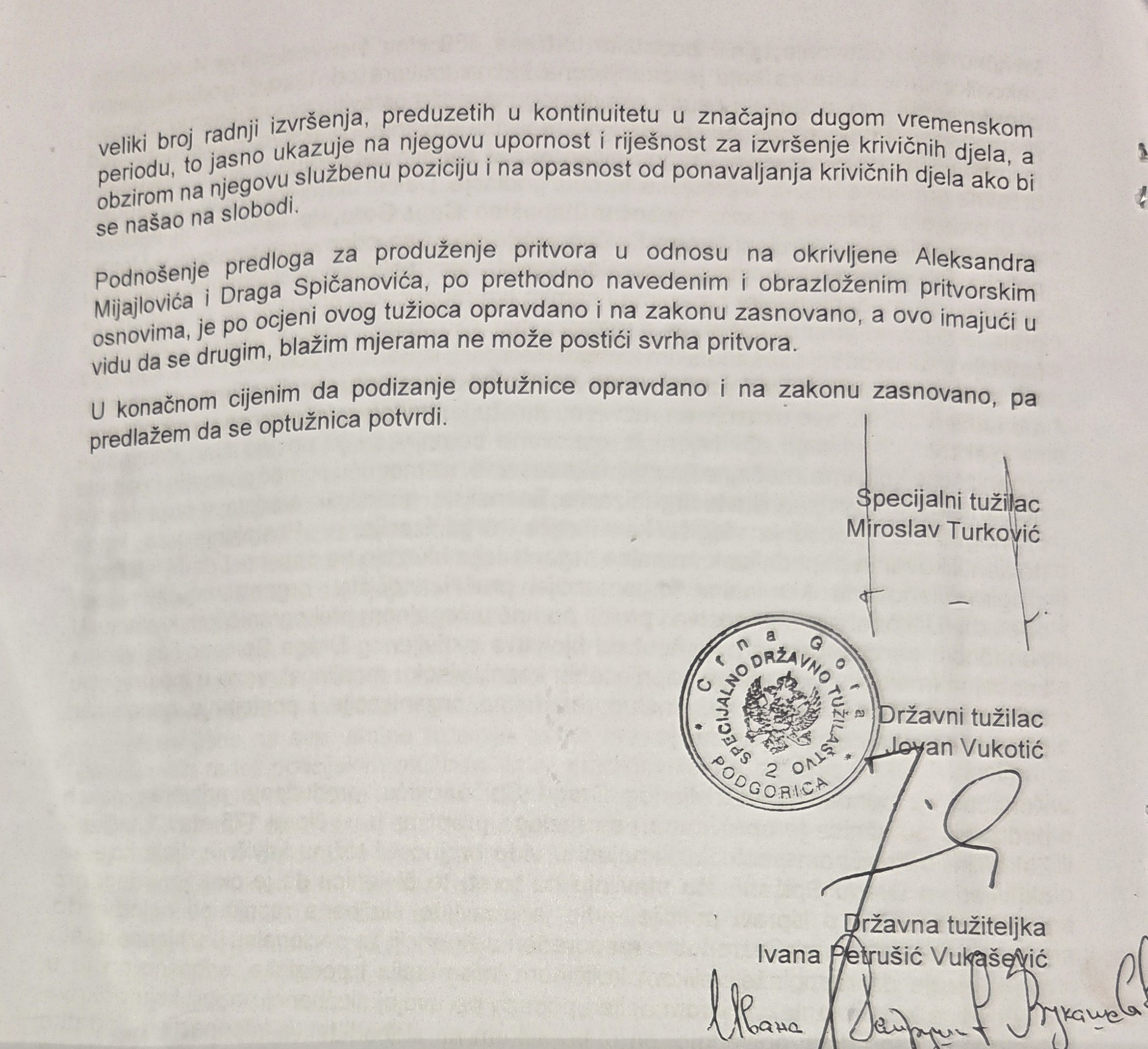
That, evidently, was the reasoning of the trio of special prosecutors - Jovan Vukotić, Ivana Petrušić Vukašević and Miroslav Turković - when, on Friday, July 31, they requested the recusal of the three-member panel of the High Court.
SPECIAL BIAS OF THE SPECIAL PROSECUTORS
Not because the judges had acted outside legal norms. Not because they had violated the Criminal Procedure Code.
No, the three special prosecutors sought to remove the High Court judges from the case simply because they dared, because they had the audacity, to return the indictment against Podgorica businessman Aleksandar Mijajlović and five other defendants for revision.
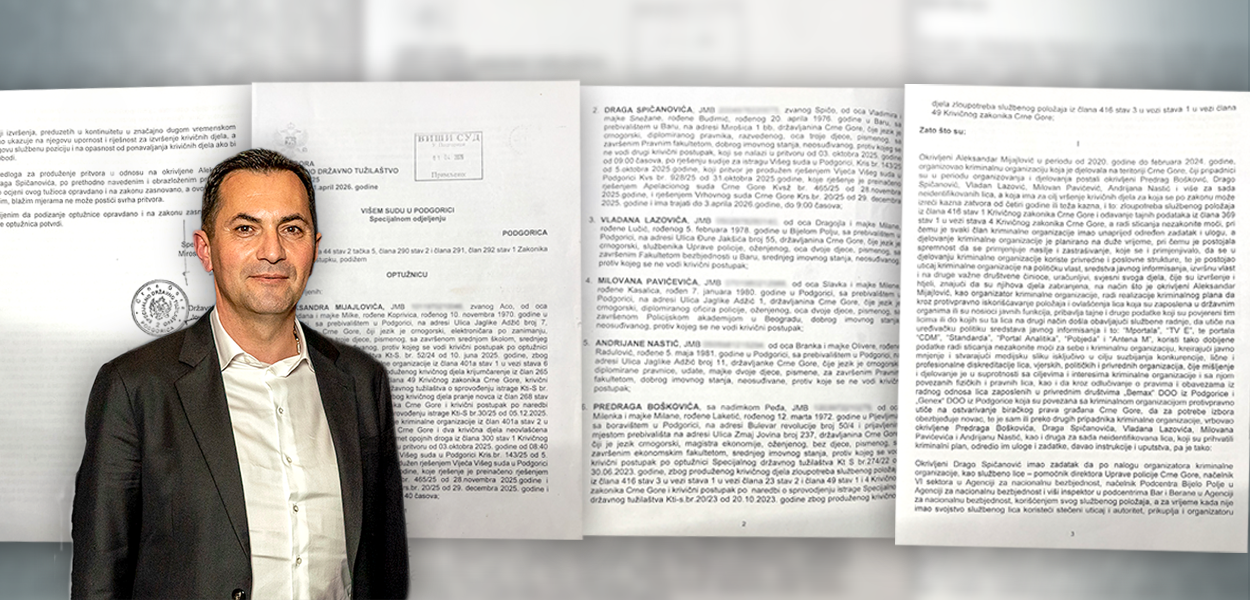
If one reads the reasoning behind the High Court's decision, signed by High Court President Zoran Radović, former High Court President Boris Savić, and veteran judge Vesna Kovačević, then the frustration, irritation and extraordinary reaction of the special prosecutors become much easier to understand.
Because the High Court's ruling exposed a disturbing truth: there is a direct correlation between the political actions of those in power and the activities of the Special State Prosecutor's Office. More precisely, whoever is politically targeted by the leaders of the post-August government soon becomes the target of the Special Prosecutor's Office as well.
AN INDICTMENT - WITHOUT A CRIMINAL OFFENCE?!
The High Court's ruling revealed a shocking fact to the public: the special prosecutors failed to present a single piece of evidence that businessman Aleksandar Mijajlović gave orders, instructions or recruited anyone into a criminal organisation. On the contrary, even the prosecution's own witnesses explicitly denied any influence on political developments or the electoral process.
As if that were not enough, the prosecutorial trio even attempted to charge Aleksandar Mijajlović, who is neither a public official nor a civil servant, with the criminal offence of abuse of office.
From this alone, the conclusion is clear: Aleksandar Mijajlović was first branded by the post-August authorities, and only afterwards prosecuted by the Special State Prosecutor's Office.
The manner in which he was prosecuted is a story in itself. Across nearly 300 pages of the indictment, the prosecutorial trio failed to formulate any criminal offence related to Mijajlović's alleged unlawful influence over six media outlets. Above all because influencing the media is not, in itself, a criminal offence - a fact known even to first-year law students.
ABUSE OF THE PROFESSION
This is not a matter of ignorance on the part of the three special prosecutors. It is about political intent and the abuse of the prosecutorial profession.
The facts speak for themselves. While defence lawyers were still bound by the obligation to preserve the confidentiality of the investigation, the Order to Launch the Investigation against Mijajlović and five other individuals was handed directly to a Vijesti journalist, enabling the scandalous targeting of the leading figures of the „undesirable“ media.
That is only one piece of the puzzle of abuses. While shamelessly targeting editors and senior managers of six critical media outlets, the prosecutorial trio deliberately concealed Mijajlović’s telephone communications with a manager of the Vijesti media group. Had defence lawyer Zoran Piperović not publicly disclosed this fact, the Special State Prosecutor’s Office would likely never have summoned the director of Vijesti to testify.
What should this be called, if not the special political bias of the special prosecutors?
TARGETED AND PRIVILEGED MEDIA
Why was communication between certain media outlets and the owner of a media buying agency treated as a criminal offence, while identical communication between representatives of another media outlet and that very same owner of the media buying agency - again, Aleksandar Mijajlović - was regarded as perfectly legitimate business activity?
That question alone lays bare the Special State Prosecutor’s Office’s insidious intentions.
Likewise, the silence of Vijesti and the other media outlets evidently favoured by the prosecutors - which chose not to report that the indictment had been returned for revision - demonstrates the unhealthy relationship between the Special State Prosecutor’s Office and certain media organisations that appear all too willing to serve it.
The facts are clear. By accommodating politicians in power, the special prosecutors sought to criminalise media outlets that are critical of the government and not to its liking.
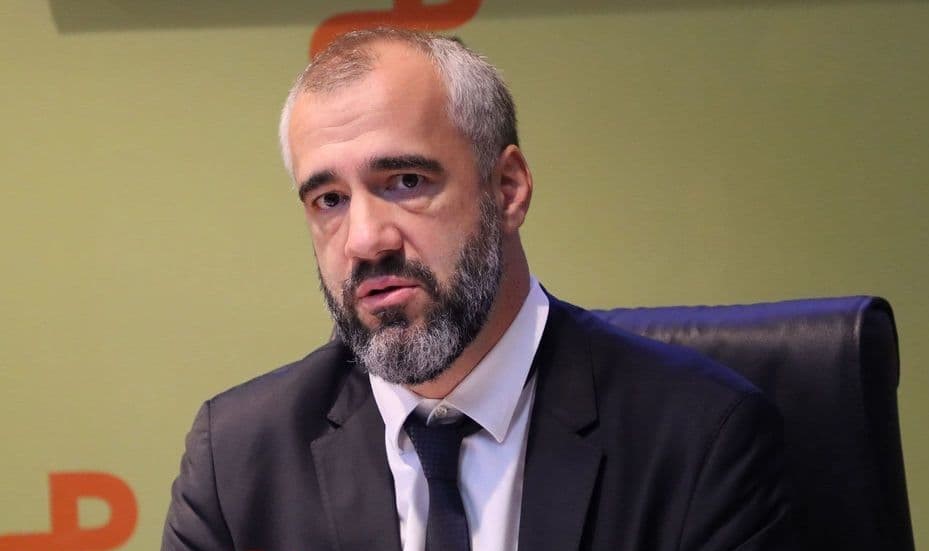
Nor is this the first time. In July 2024, Special Prosecutor Miloš Šoškić targeted six journalists - Kaćuša Krsmanović, Tamara Nikčević, Šeki Radončić, Darko Šuković, Samir Rastoder and myself, Draško Đuranović, then editor-in-chief of Pobjeda, as well as the award-winning writer Milorad Popović.
Prosecutor Šoškić shamelessly attempted to use the longstanding professional and civic communication between media professionals and former Chief Special Prosecutor Milivoje Katnić as grounds to criminalise free and critical journalism.
Following a strong public backlash, Šoškić formally fell silent, as did his superior, Chief Special Prosecutor Vladimir Novović.
Now that this troubling history is repeating itself, Novović remains silent once again.
The Chief Special Prosecutor ought to speak up and explain: did he ask his special prosecutors why they decided to take this unprecedented step?
THE RULE OF FORCE, NOT THE RULE OF LAW
All the more so because this is without precedent. Since the establishment of the Special State Prosecutor’s Office in March 2015, special prosecutors have never before sought the recusal of judges. Yet this time they did so, claiming political bias on the part of the court, as prosecutor Jovan Vukotić asserted.
An interesting claim indeed. When, in July 2024, High Court President Zoran Radović acquitted all defendants initially convicted over the alleged October 2016 coup attempt - including nine Serbian nationals who had pleaded guilty - the Special State Prosecutor’s Office did not consider seeking the recusal of the presiding judge despite what many regarded as an obvious legal inconsistency.
Now, however, when that same Judge Radović, together with his colleagues, returned the indictment against Mijajlović as a legally deficient document, the prosecutors immediately reached for a motion seeking the judges’ disqualification.
That explains the current anger of the special prosecutors. The High Court’s decision is the ultimate proof of brutal political instrumentalisation; proof that the indictment, drafted in the manner it was, was an attempt to continue the political persecution of Aleksandar Mijajlović and to undermine the key principle enshrined in Article 1 of the Criminal Procedure Code - that the purpose of the law is to ensure a fair criminal trial and, I quote, that „no innocent person shall be convicted“.
The relentless requests to extend pre-trial detention are themselves evidence that certain special prosecutors want detention to become a form of punishment, and that they - not the courts - should decide guilt.
This raises an important question: will Montenegrin society continue to watch in silence as the law is abused and the prosecution service, and the judiciary as a whole, is politicised? Will the Judicial Council speak out? Will the Supreme Court find its voice?
Because, in the end, one should not forget the old Latin maxim: „Where the accuser is also the judge, force prevails instead of law“.