




The „Secret Police“ as a tool of power for the ruling elites, instead of comprehensive reform
The reintroduction of the Draft Law on the National Security Agency (NSA) onto the agenda of a parliamentary session whose content is not known in advance would represent a serious violation of democratic culture. Laws that affect human rights must be adopted exclusively through an open, inclusive, and responsible process in order to ensure compliance with international standards, Montenegro’s obligations toward the EU, and international human rights bodies, the Human Rights Action (HRA) warned yesterday

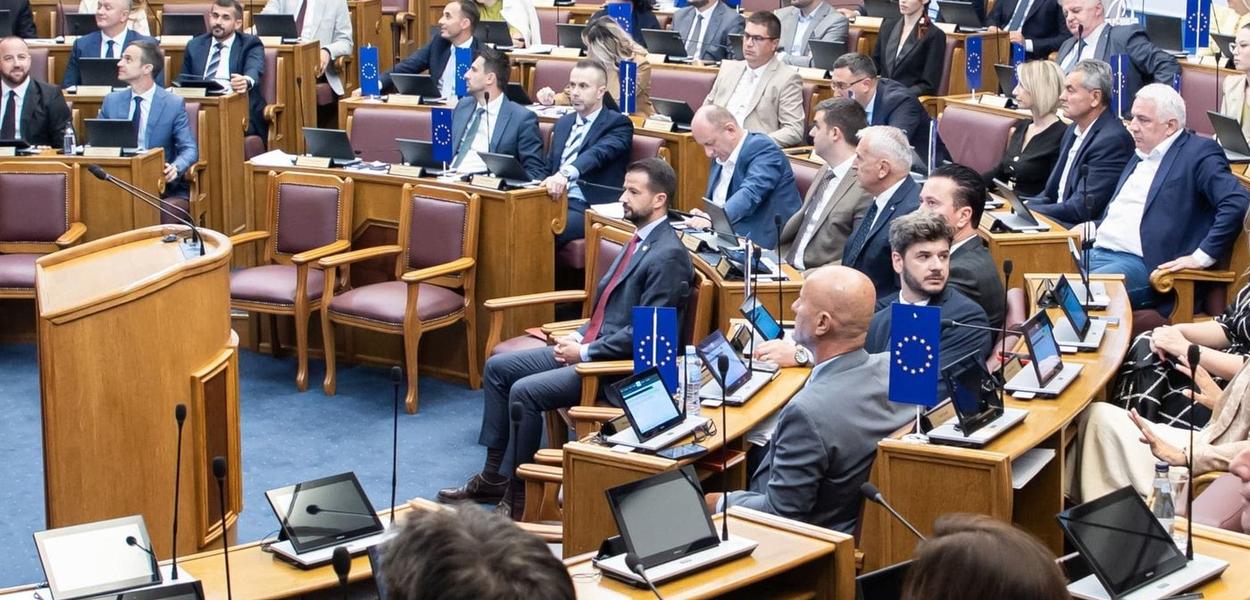
The Draft Law on the National Security Agency could appear on today’s parliamentary agenda, despite the fact that civil society organizations warned during the summer that some of its provisions grossly violate human rights, after which it was withdrawn from procedure, only to be reinserted into the plan for the fourth session of the second regular (autumn) sitting.
Human Rights Action announced yesterday that, „taking into account the statements of Minister of Justice Bojan Božović that no law under the jurisdiction of the Ministry of Justice would be adopted without the opinion of the European Commission“, they requested that the „Ministry of Justice and the Ministry of European Affairs publish the opinion of the European Commission on the Draft Law on the NSA and the Draft Law on Internal Affairs“.
- The public must be given insight into the compliance of draft laws with European standards, upon which the country’s accession to the EU directly depends, and which should be the primary general interest. Reintroducing the Draft Law on the NSA onto the agenda of a session whose content is not known in advance would constitute a serious breach of democratic culture. Laws affecting human rights must be adopted exclusively through an open, inclusive, and responsible process in order to ensure respect for international standards, Montenegro’s obligations to the EU, and international human rights bodies - HRA warned.
COMMITTEE REPORT
In the report of the Committee on Security and Defence on the consideration of the Draft Law on the National Security Agency, submitted to Parliament on December 24th, it is stated, among other things, that at the sessions of this parliamentary body held in July “it was noted that, in drafting the Draft Law, normative solutions used in the legislation of neighboring countries that have similarly refined the legal framework of their operations (partner services, NATO and EU member states) were taken into account“.
- It was also emphasized that, in drafting the proposed amendments, respect was ensured for human rights and freedoms established by the Constitution of Montenegro and the European Convention for the Protection of Human Rights and Fundamental Freedoms, and that a balance was established between respect for individual human rights and the right of a democratic society to protect national security interests - the Committee report states, also noting that „the need to adopt the Law under an urgent procedure was highlighted“.
The Committee on Security also noted that „during the debate, discussion focused on the scope of powers of the Director of the National Security Agency envisaged by the proposal, as well as potential abuses of surveillance measures and related civil liberties“.
- The need to find compromise solutions between the protection of civil rights and individual privacy and the effective functioning of the NSA was emphasized. In this regard, the Government submitted eight amendments to this Draft Law, taking into account the remarks and suggestions of the participants in the session. These amendments became an integral part of the Draft, and Parliament, in accordance with Article 150, paragraph 3, does not vote on them separately - the document states.
However, HRA warned yesterday that reintroducing the Draft Law on the ANB onto the agenda, while its content remains unknown, would represent a serious violation of democratic culture.
- The president of the Parliament Andrija Mandić stated that the draft laws in this case were removed from the agenda in order to improve communication with the public and international partners. However, this draft law has not been communicated to the public, no public debate has been held, nor has the public been informed about the opinion of the European Commission. The same applies to the amendments to the Law on Internal Affairs, which, despite this, have meanwhile been pushed through two parliamentary committees. In such a non-transparent situation, it is easy for laws to be adopted that do not meet human rights protection standards, which Montenegro must accept prior to EU accession - HRA emphasized.
APPEALS WITHOUT RESPONSE
More than 20 non-governmental organizations pointed out that the Government’s eight amendments, submitted on July 29th, several hours after the session of the Committee on Security at which the Draft Law on the NSA was discussed, failed to resolve the issue of serious human rights violations. They called on Parliament to withdraw the draft from procedure.
- If such a law is adopted today, Montenegro will miss a crucial opportunity to establish a service that works in the interest of citizens rather than political elites - thereby further endangering the process of democratization, the rule of law, and European integration - the NGOs announced on July 31st.
They warned that the draft law was prepared in secrecy, without a public debate, without an analysis of its impact on human rights, and without harmonization with international treaties and the legal acquis of the European Union (EU).
- This is a picture of a government that merely seeks to appropriate the levers of power, viewing the secret police as one of the most important among them - civil society organizations stressed.
They warned that „the goal of the urgent adoption of this legal text is, before the statutory retirement deadline, to remove from service those employed during the former government, in order to bring in individuals loyal to the new authorities without public competition or professional testing, as well as to remove the NSA from the public procurement system“.
- Through this law, extremely broad powers are placed in the hands of a service that has never been substantively reformed, while the public has been deprived of full information about who has been held accountable and how for past abuses. There is an obvious intention to reduce space for civic oversight and to further transform the institution itself into a dangerous tool or weapon in the hands of politicians - civil activists were categorical.
They concluded that the Government had proposed „amendments that essentially maintain the status quo“.
European Commission spokesperson Guillaume Mercier told „Vijesti“ on July 29 that “the European Union expects Montenegro to provide appropriate clarifications regarding the purpose and scope of the proposed amendments to the Law on the National Security Agency, including enabling the European Commission to conduct a thorough analysis, before proceeding with the adoption process of that law.
- Any legislative or institutional change in this area must be carried out through a transparent and inclusive process of public consultations, with all measures being lawful, proportionate, clearly justified by specific needs, and aligned with the principles of democratic oversight and respect for fundamental rights - he said at the time.
However, a transparent and inclusive process of public consultations did not take place, and to this day the public has not been informed of the European Commission’s assessment of the Draft Law on the National Security Agency.