



Joković to farmers: Our success will not be measured solely by how many EU rules we adopt, but also by whether more young people choose to stay and build their future here

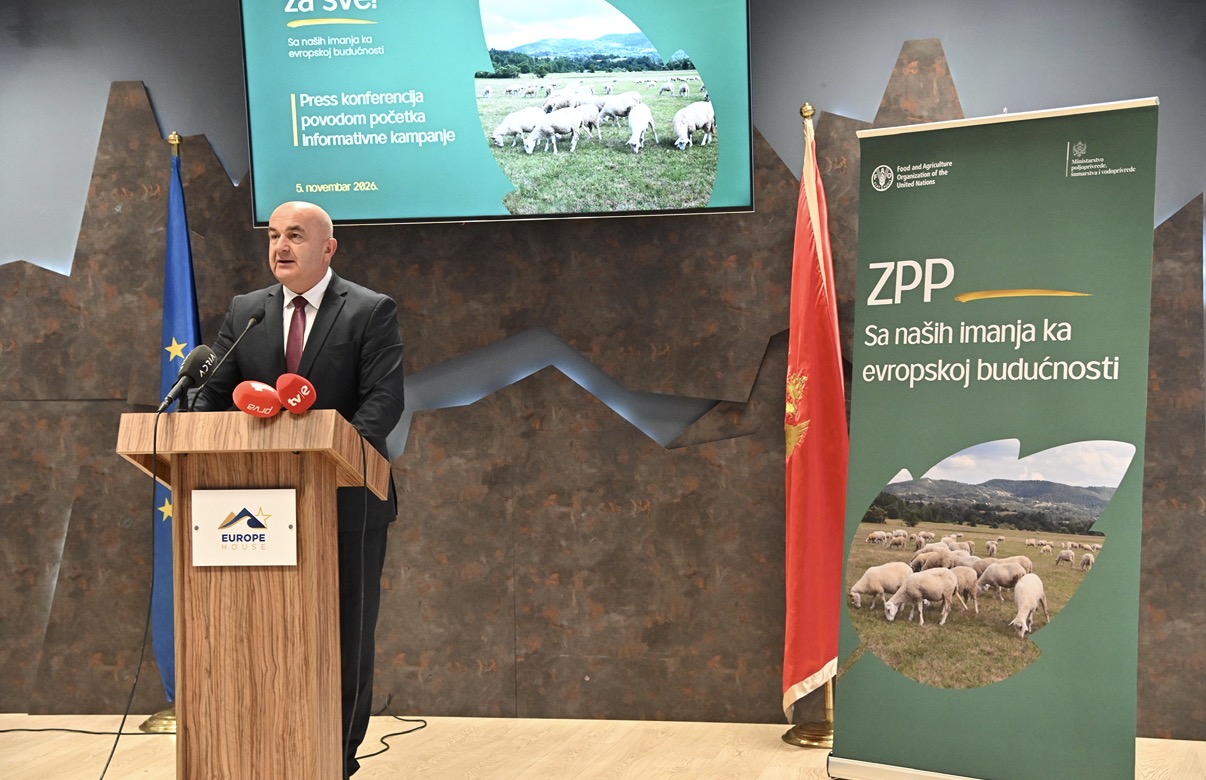
The European Union will not solve all the problems facing our agriculture overnight. However, I am confident that it offers us an opportunity to begin addressing many of these challenges more effectively, systematically and with a longer-term perspective than before. We will not measure our success solely by how many European rules we have adopted or how much funding we have used. We will also measure it by whether more young people see a reason to stay, work and build their future in rural areas – said Montenegro's Minister of Agriculture, Forestry and Water Management, Vladimir Joković.
In his letter to farmers, marking the launch of the campaign „Common Agricultural Policy (CAP) for All - From Our Farms Towards a European Future“, he noted that Montenegrin agriculture had been shaped by the country's mountains and pastures, small family farms, traditions of livestock breeding and food production, but above all by generations of hardworking farming families who have preserved their farms and villages even under difficult conditions.
- By European standards, our agriculture is small. But for Montenegro, its importance far exceeds its size. Our food supply, the life of our villages, the appearance of our landscapes, part of our tourism offer and the preservation of traditions we wish to pass on to future generations all depend on it. That is why agriculture must have an important place in our European future - Joković emphasised.
His letter is reproduced in full below:
„Dear farmers, dear farming families,
Montenegro is getting closer to membership in the European Union. For our country, this is a historic step. But for me, as Minister of Agriculture, it is equally important what this step will mean for the person who gets up every morning to feed livestock, cultivate the land, produce food and secure a future for their family.
I want Montenegro's European future to also be the future of our farmers. Not only of the largest and most successful ones, but also of the thousands of families who make a living from their farms and sustain life in our villages.
I know that many of you look forward to joining the European Union with hope, but I am also aware that there are questions and concerns. Will our small farms be able to survive? Will we be able to meet European standards? Will subsidies change? Will our production be able to withstand competition from large European producers?
I do not wish to answer these questions with easy promises. The European Union will not solve all the problems facing our agriculture overnight. However, I am confident that it offers us an opportunity to begin addressing many of these challenges more effectively, systematically and with a longer-term perspective than before.
Our agriculture does not have to resemble that of the large European countries in order to be successful.
Montenegrin agriculture has been shaped by our mountains and pastures, small family farms, traditions of livestock breeding and food production, but above all by generations of hardworking farming families who have preserved their farms and villages even under difficult conditions. We may not always be able to compete with large European producers in terms of quantity and price, but we can compete through quality, authentic products, their origin, and by linking agriculture with tourism and our natural environment. What sets us apart from others should not be our weakness, but rather an advantage that we must know how to preserve and make the most of.
The European Union brings together countries with very different agricultural sectors. This is precisely why its Common Agricultural Policy allows Member States, within a shared framework of rules, to tailor support to their own needs.
Our task is not to replicate European agriculture in Montenegro. Our task is to find the best place for Montenegrin agriculture in Europe.
We are not starting from scratch on this journey. For years, we have been working to align legislation, strengthen institutions and develop support systems. We have established the Register of Agricultural Holdings and conducted a new Agricultural Census. Through support measures under the Agricultural Budget, we have improved standards in food production and processing and created conditions that enable small producers to develop their businesses more easily.
Through the IPARD programme, we have supported the modernisation of agricultural holdings and processing facilities, improved production quality and helped producers gradually meet European standards. In doing so, we have created more competitive agricultural producers who are better prepared for the European market.
These are not merely obligations we fulfil as part of the EU accession negotiations. They are changes that our agricultural sector needs, regardless of the date of our accession.
Nevertheless, much important work still lies ahead. We must improve our land records, bring existing subsidies into line with European rules, strengthen advisory services and help agricultural holdings meet new standards. It is equally important to protect the origin and distinctive character of our traditional products, promote them more effectively and open up access to new customers, both in Montenegro and across the European market.
I also want to be clear about one more thing: European funding alone will not create a competitive agricultural sector. That can only be achieved by people who have the knowledge, invest, cooperate, improve production and find their place in the market. The state must help them achieve this.
That is why I believe that, in the years ahead, we must invest even more in knowledge, advisory services, young farmers, producer associations and better conditions for selling domestic products. It is not enough to help farmers produce more if we have not also helped them process, market and sell their products at a fair price.
It is important that we remain realistic and responsible in our expectations. EU membership does not automatically mean higher levels of support for every farmer. Future support will depend on European rules, our negotiations and the decisions we make regarding the priorities of Montenegrin agriculture.
However, I want us to strive for a system in which support is more predictable, rules are clearer and opportunities are accessible to those who genuinely work the land and wish to develop their farms.
I am not asking you to believe that everything will be easy. I am asking you to believe that preparing for this future is worthwhile.
That is why I encourage you to stay informed, learn and ask questions. Check the information concerning your agricultural holding and the land you use. Talk to advisory services. Think about what you can improve in your production, quality and sales. Do not wait until the day of accession to start preparing your farm.
And we at the Ministry have an obligation to ensure that you are not left alone on this journey. We must explain changes to you in a timely manner, listen to your concerns, simplify procedures wherever possible and represent the genuine needs of our agricultural sector in the accession negotiations.
I would particularly like to address young people who are considering whether to stay on their family farms or seek their future elsewhere.
We will not measure our success solely by how many European rules we have adopted or how much funding we have used. We will also measure it by whether more young people see a reason to stay, work and build their future in rural areas.
By European standards, our agriculture is small. But for Montenegro, its importance far exceeds its size. Our food supply, the life of our villages, the appearance of our landscapes, part of our tourism offer and the preservation of traditions we wish to pass on to future generations all depend on it. That is why agriculture must have an important place in our European future.
Years of work and change lie ahead of us. But I believe we can build an agricultural sector that preserves the best of what we have while becoming more productive, resilient and competitive.
We are not joining the European Union to stop being who we are. We are joining in order to have more opportunities to preserve, improve and pass on what we have to future generations.
I am counting on you in this endeavour. And I want you to know that you can count on us.“