




Zvinchuk and four other Russian nationals expelled from Montenegro on security grounds

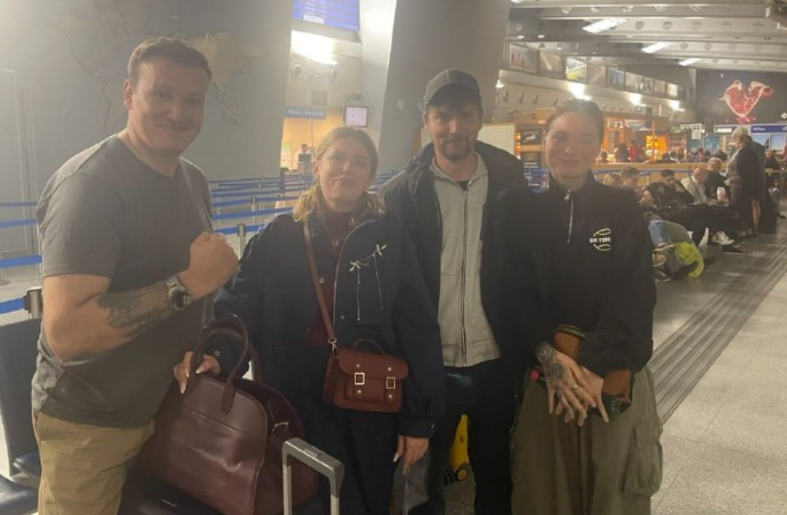
The Police Directorate and the National Security Agency (NSA) have identified five Russian nationals whose residence permits have been revoked and who have been issued expulsion orders from Montenegro on grounds of national and internal security, the Police Directorate announced.
They include Russian propagandists subject to European Union sanctions, Mikhail Zvinchuk, the head of and a member of the Russian hybrid network “Rybar”, his wife Valeria (36), as well as S. B. (36), K. D. (21) and P. L. (46), who entered Montenegro less than two days ago.
- Today, officers of the Police Directorate, together with the National Security Agency and with the support of international partners, carried out a targeted and coordinated operation aimed at preventing, detecting and neutralising illegal activities on the territory of Montenegro - the statement said.
Following criminal, operational and intelligence checks, it was established that these individuals could not continue their stay in Montenegro. Accordingly, expulsion orders were issued against them, in accordance with the Law on Foreigners, on grounds of national and internal security.
- The individuals had been staying at a hotel in Risan, in the municipality of Kotor, after which they were taken to police premises for further official measures and procedures - the Police Directorate said.
During the investigative procedures, digital equipment and devices were found in the possession of the Russian nationals and seized, including high-resolution equipment, a drone, a camera, a GoPro camera and several mobile phones.
- The seized equipment will undergo appropriate forensic examinations and analyses to determine its intended purpose and the purpose for which it was to be used on the territory of Montenegro - the Police Directorate announced.
The Higher State Prosecutor’s Office in Podgorica and the Basic State Prosecutor’s Office in Kotor were notified of the incident.
According to the Police Directorate, the European Union has imposed a restrictive measure on Zvinchuk banning him from entering or transiting through the territory of EU member states because of activities that undermine or threaten Ukraine’s territorial integrity, sovereignty and independence.
- Through a timely and coordinated response, the security and intelligence authorities prevented the potentially harmful activities of these individuals on the territory of Montenegro, confirming the institutions’ commitment to the consistent enforcement of the law, the protection of national security and the strengthening of the rule of law, as key principles underpinning European integration and the fundamental values of modern Europe - the statement said.
The Police Directorate and the NSA said they would continue their joint and coordinated activities to protect Montenegro’s national and internal security, maintain a stable security environment, prevent illegal activities, and identify and counter security risks and threats in a timely manner, while continuously improving the safety of all citizens.
They were arrested in Risan earlier today. After the information was announced, Prime Minister Milojko Spajić said he would not disclose information that must remain within the remit of the security services.
- But the message following today’s successful operation, in which the head of the Rybar information network was detained, is clear: the institutions are doing their job, Montenegro is protecting its interests, and no one will jeopardise our European future - Spajić said on the social network X.
He added that warnings had been issued that attempts at hybrid operations and destabilisation were persistently accompanying Montenegro on its European path.
- This is not the time for hasty statements, but neither is it the time for naïve conclusions - Spajić said.
According to him, there are serious indications that require every lead to be carefully examined and every connection assessed in a broader context.
Unlike in Western Europe, where they had to keep a low profile, Zvinchuk and Rybar were welcomed at an institutional level in Republika Srpska, the Serb-majority entity within Bosnia and Herzegovina, M portal reports. Investigations by Balkan investigative media, such as the Detektor portal, revealed that Rybar had reached a direct agreement with Republika Srpska’s Agency for Information and Communication Technologies to establish a so-called “media school”.
The aim of this school was simple: to train a new generation of local journalists and bloggers in Russian methods of information warfare.
Zvinchuk openly stated that the region needed to learn to function “without Western platforms such as Facebook and X”, using Telegram instead as its primary weapon for destabilising the Western narrative.
Zvinchuk’s presence was recorded in Banja Luka even during sensitive political processes and snap elections in 2025, when he publicly commented that Republika Srpska and Kosovo were “hostages to a larger geopolitical game” and weak points through which the West was putting pressure on Russia.
Serbia served as a regional springboard for the Zvinchuk couple. While building institutional ties in Bosnia and Herzegovina, they operated in Belgrade in a semi-private but highly public sphere.
Zvinchuk regularly delivered lectures and masterclasses at the iconic Hotel Moskva in Belgrade.
These lectures attracted local pro-Russian activists, right-wing administrators of Telegram channels and certain media figures. Through the regional channel “Balkanar”, which is directly linked to the Rybar network, an information system was created that disseminates targeted anti-Western and anti-NATO narratives on a daily basis, tailored to the local mentality and the region’s historical traumas.
The connection with film director Emir Kusturica represents the culmination of Rybar’s penetration into the cultural and social elite of the Balkans.
Kusturica, known for his strong pro-Russian views, provided Zvinchuk with an ideal platform for legitimising his work.
Zvinchuk was a prominent guest at Kusturica’s Drvengrad complex in Mećavnik, where a documentary film festival was held under the telling title “RT.Doc: Time of Our Heroes”, organised by Russian state broadcaster RT.
It was from Mećavnik that Zvinchuk sent messages about the need for Serbian-Russian unity in the “defence of traditional values” and the fight against Western cultural hegemony. Kusturica’s support and authority served as the perfect cover for packaging a military intelligence project and an EU-sanctioned propaganda channel in the guise of “alternative culture” and artistic freedom.
“Rybar” is, as Pobjeda writes, a Russian media and information network founded in 2018 that gained international recognition during Russia’s invasion of Ukraine. Originally conceived as a platform for military analysis and conflict reporting, it gradually developed into an extensive network of communication channels that Western institutions associate with the dissemination of pro-Russian narratives, propaganda activities and information influence operations.
The network’s founder and one of its best-known representatives is Mikhail Zvinchuk, a former member of the information structures of Russia’s Ministry of Defence. In 2018, Zvinchuk and Denis Shchukin founded Rybar, which later became one of the most influential Russian military channels on Telegram.
Zvinchuk has been under European Union sanctions since June 2023. The Council of the EU stated in its explanation of the decision that, in addition to running the Rybar channel, he was a member of a working group established by Russian President Vladimir Putin to coordinate activities related to the war in Ukraine. The European Union links him to the dissemination of disinformation and propaganda in support of the Kremlin.
British authorities have designated the Rybar network as one of the actors involved in Russian foreign information manipulation and interference operations. According to their statements, the network’s activities are partly coordinated by the Russian presidential administration, it receives financial support from Russian state corporation Rostec, and its operatives cooperate with members of Russian intelligence services.
The British government also states that, in addition to publishing military analyses, Rybar uses anonymous media accounts, purported research and AI-generated content to influence public opinion and promote narratives aligned with the Kremlin’s interests.
In July 2026, the United Kingdom imposed additional sanctions on individuals linked to the organisation as part of measures targeting Russian information operations.
The expansion of Rybar’s activities beyond Russia, including into the Western Balkans, has attracted particular attention from Western security and analytical circles.
According to a November 2024 analysis by the US-based Institute for the Study of War (ISW), Zvinchuk spoke of an international network comprising more than 250 communication channels in 28 languages, as well as the opening of media schools in Serbia, Bosnia and Herzegovina, and Kyrgyzstan.
Analysts view such activities within the broader context of Moscow’s efforts to strengthen its information influence beyond its borders through media and digital platforms, particularly in countries exposed to geopolitical tensions and competing international interests.
The US State Department has publicly identified several individuals associated with Rybar through its Rewards for Justice programme, citing suspicions of the network’s involvement in foreign influence operations.
Precisely because of the organisation’s international reach and its links to structures that Western countries associate with Russian intelligence and propaganda activities, Rybar’s operations are of interest to security institutions in several countries.
Russian diplomats intend to establish the reasons for the detention of Mikhail Zvinchuk, founder of the Rybar project, Kremlin spokesman Dmitry Peskov said.
Dmitry Medvedev, Deputy Chairman of Russia’s Security Council, said that it would now “quite probably be necessary to replenish the pool of citizens from the US and European countries in order to exchange them for Russians”.
Medvedev also expressed the view that Russian citizens were travelling to Europe in vain, even if they had good intentions and important objectives.
- Potentially, all Russians - I stress, all of them - have been declared fair game - Medvedev said.
The five Russian nationals left Montenegro during the night of 9 October.