




Vujović: Participation of civil society in EU negotiations has been brought to the brink of being rendered meaningless, it is important that Montenegro does not go to early elections

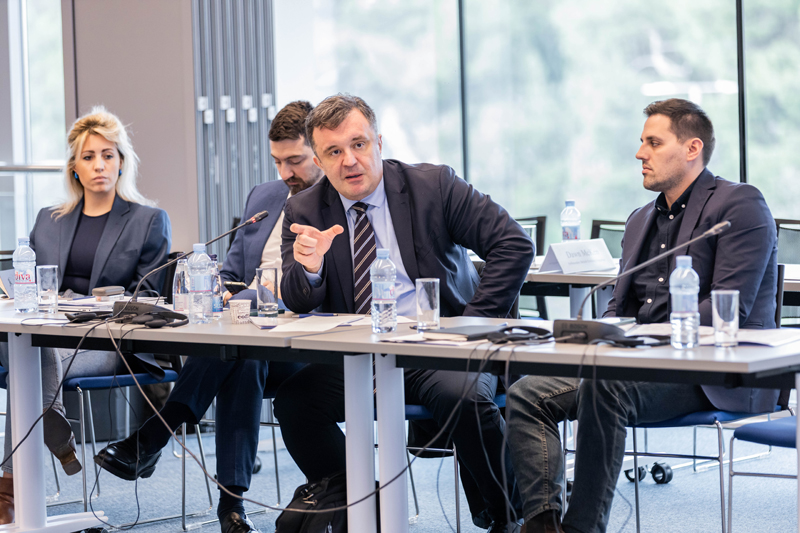
No major progress should be expected in Montenegro’s European Union accession process over the next year, but rather minimal results with a maximum outcome – assessed Executive Director of the Centre for Monitoring and Research Zlatko Vujović.
Appearing as a guest on the morning show Budilnik on Television E, Vujović said that the Draft Programme for Montenegro’s Accession to the European Union for the period 2026–2027 is primarily a technical document focused on the dynamics of activities that have already begun.
- In the next year, there will be no major breakthroughs in the accession process, these will be minimal results with a maximum outcome. Accordingly, the Draft Programme for Montenegro’s Accession to the European Union 2026–2027 is a document that explains how to package everything that has already been done and work on the dynamics, which is supported by the announcement that one negotiating chapter will be closed next week. It is more about technical matters than about strict criteria - Vujović said.
The Draft Programme for Montenegro’s EU Accession for the period 2026–2027 was presented yesterday at the Europe House. Although the meeting was closed to the public, it raised numerous questions about the realism of the set deadlines, as well as the quality of the reforms ahead.
Vujović believes that the document brings nothing spectacular, but rather represents a realistic plan for completing negotiations within the projected timeframe. As he noted, the European Union has not set strict criteria, but flexible requirements, primarily due to the short time frame.
- We must conclude the negotiations this year, and the minister has already announced the closure of one negotiating chapter as early as next week, which best illustrates this pace. It is more about, conditionally speaking, avoiding mistakes and packaging what has already been completed so that we can achieve the expected results in such a short period of time. Let’s be honest, the administration does not correspond to the moment we are in. I am not talking about the minister, the minister is doing an excellent job. I am talking about people in various ministries who are responsible for obligations within specific chapters. Montenegro truly has insufficient negotiating capacity when it comes to people in technical positions, but that is now less important. I like to say, despite being very critical of some of the capacities and steps we have taken in fulfilling the plan, one thing must be acknowledged - Montenegro is far more prepared to join the European Union than any previous country that became an EU member, including Croatia at the time - Vujović said.
Speaking about the inclusiveness of the negotiation process, Vujović assessed that the participation of civil society has been brought to the brink of being rendered meaningless, alongside an accelerated pace of adopting laws that is difficult to follow.
- As dissatisfied as I am on the one hand, on the other hand I will give priority to Montenegro completing the negotiations as early as possible and seizing this opportunity, because we will never again be given a chance like the one we are in now - he emphasized.
According to Vujović, the announced closure of one negotiating chapter next week is proceeding in line with the plan, with minor corrections, which, as he says, indicates that the plan could be fulfilled within the next two years. However, he warns that the main risks are political rather than technical.
- I believe the main risks are political, not so much technical, not so much the relations between the Government and the European Commission, but above all whether certain political parties will try to bring down the Government, or whether what is happening around Botun represents an attempt to stop at all costs something what the EU has identified as the absolute minimum for Montenegro to fulfill part of its obligations in one chapter. I think Montenegro faces fewer risks in the technical part of fulfilling obligations and more in the political sphere, because we must be honest and say that a significant part of the ruling coalition does not want Montenegro to be in the European Union - Vujović added.
He also noted that some of the ministers responsible for the negotiations are strong opponents of those negotiations ever being concluded.
- So how can we assess the success of certain ministries and ministers if they will do everything to at least prolong the process because of their political interests? The biggest risks are political, stability and the fulfillment of obligations, primarily in parliament. It is extremely important that Montenegro does not go to early elections and that we have a pro-European majority in parliament together with the opposition, in order to prevent a possible attempt by part of the ruling coalition to block the adoption of certain legislative solutions and slow down the fulfillment of the European agenda - Vujović concluded.