




Milatović: Avoiding parliamentary debate could further deepen the institutional crisis

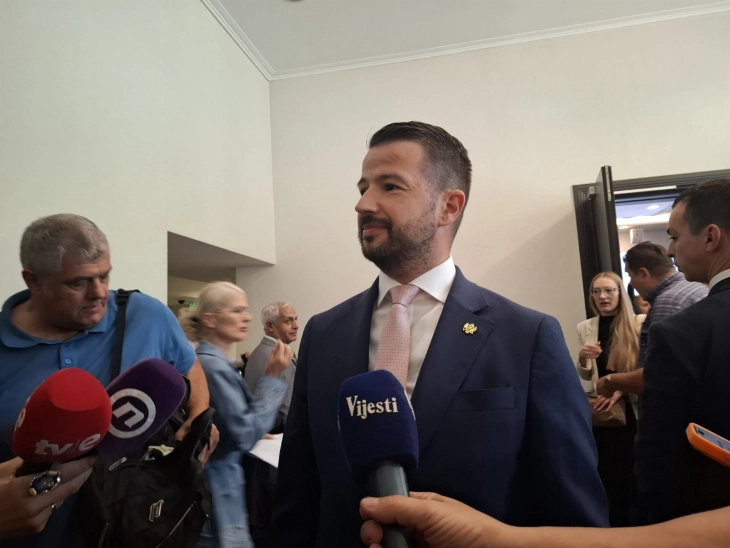
Avoiding parliamentary debate on important issues is not good for parliamentary democracy and could further deepen the institutional crisis, Montenegrin President Jakov Milatović said.
He said that the latest developments in Parliament, when a debate on the initiative to dismiss Parliament Speaker Andrija Mandić did not take place due to a lack of quorum, were not a positive development in the context of the emerging institutional crisis.
- Every MP has the right to their own position, but we witnessed a highly irresponsible attitude by Parliament toward journalists and the public - Milatović said in response to journalists' questions following the Anti-Corruption Forum.
He said journalists should have been allowed to report on events in Parliament and that avoiding a debate on the question of confidence was not a good thing either.
- Montenegrin citizens elected their representatives. I believe they should have had a debate. It is not good to avoid discussing something - Milatović said.
He noted that this was not the first time such things had happened in Parliament.
- Institutional irresponsibility should not be answered with institutional irresponsibility. I believe that this only further deepens the crisis and that it is not good for our parliamentary democracy - Milatović said.
According to him, such conduct also sends a poor message to Montenegro's European partners.
Speaking about the Euromodel programme, Milatović said it was incorrect to claim that he had ever been a critic of Prime Minister Milojko Spajić.
He said he had numerous commitments in New York last week and needed some time to form his position on the programme.
- Yesterday, I familiarised myself further with the six laws that were passed by the Government. It is not good that these laws were adopted so hastily and that there was no public consultation - Milatović said.
He announced that a round-table discussion would be organised, probably as early as Thursday, to which Spajić and other interested participants would be invited.
Milatović said it was good that the focus had once again been placed on increasing wages and pensions, and said Spajić's decision to bring these issues back into focus was a positive one.
However, he said there were still three questions that had not received adequate answers.
- The first is whether the programme is sustainable; the second concerns wage policy; and the third concerns the pension system and pensions themselves, which are clearly shifting from an economic category into a social one - Milatović said.
Commenting on the possibility of banning social media use for people under the age of 16, Milatović said this was an extremely important issue and that his meetings in New York had further encouraged him to put it in focus.
He said children were highly vulnerable in the digital environment and that one of the measures being discussed in numerous countries was a ban on social media use by those under 16.
- I believe we must protect our children from the digital violence that is widespread. As a parent, I am concerned about all the challenges that exist in the digital world, and I strongly support the initiative to give children back a happy childhood - Milatović said.
He said he hoped the Government and MPs would carefully consider the initiative.