




Montenegro's day, for all eternity
That 13 July 1941 was possible because „there is no other day except the one that is yet to come“, thanks to 13 July 1878. It was the great day when Montenegro – „that small country, hemmed in on all sides, yet forever fighting for freedom“ - received its final and official international recognition at the Congress of Berlin. Even today, many continue to repeat the cliché that Montenegro gained its independence at the Congress of Berlin. No, Montenegro has never been handed anything as a gift throughout its history, every one of its great days was paid for with the blood of its heroes. Those who refused to be bound in chains for a thousand years.

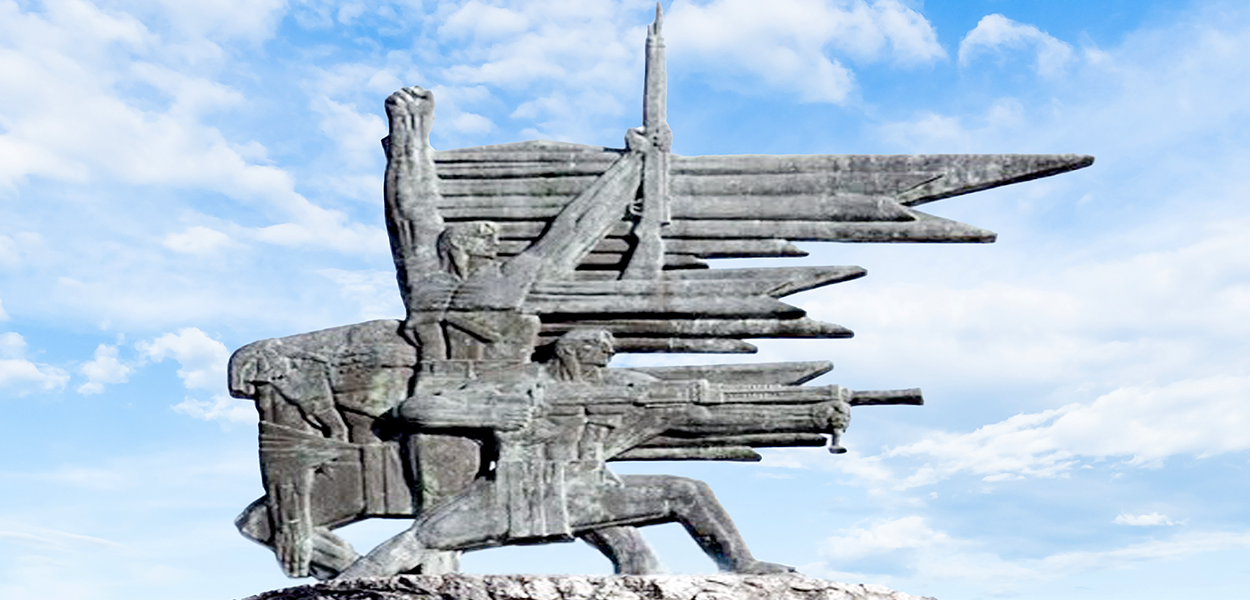
„There is no other day except the one that is yet to come“. So goes the verse of an immortal poem. And that day, that immortal Montenegrin day, is July 13.
WITH DREAMS OF VICTORY
„...We were the first to rise, consumed with indignation. / With dreams of victory - with dreams alone. / Whether alone or swallowed by the darkness, something within us struggled to breathe. We stood alone, yet once again we were the first. / Amid the lifeless stones being ground to dust by shellfire..."
(Original: ,, ...Bili smo prvi koji koji ustadosmo, ogorčeni. / Sa snovima o pobjedi – sa snovima./ Svejedno sami, svejedno u tami, nešto je grcalo u nama. Bili smo sami, opet prvi. / Sred mrtvog kamenja koje granata mrvi...“)
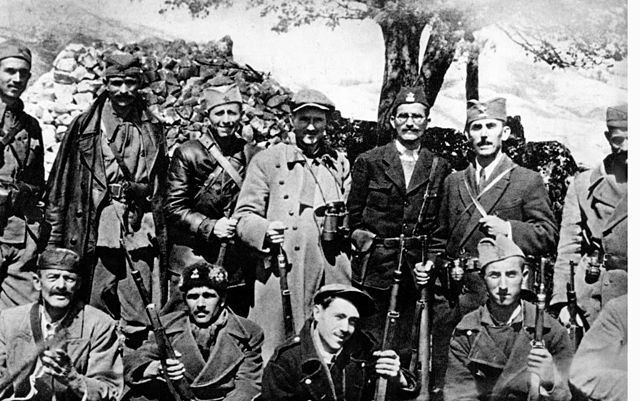
These lines are taken from the poem When We Stood Alone by the great Dušan Kostić, dedicated to the great 13 July Uprising, the first popular uprising in occupied Europe during the Second World War.
The occupier's artillery did not crush Montenegro, because Montenegrin freedom has never been something that could be crushed.
„Keeping the rebellious Montenegrins under submission is like ploughing the sea,“ Pirzio Biroli, commander of the Italian occupation forces in Montenegro, reported to the Supreme Command in Rome on 2 August 1941.
That „small country hemmed in on all sides“ raised its head and showed the world what it means to love freedom. And what it means to sacrifice for it. During the Second World War, more than 18,000 Montenegrin women and men lost their lives, while around 40,000 people perished in concentration camps or as victims of occupation reprisals. One in every ten inhabitants gave their life for a free, anti-fascist Montenegro, the one reborn in the flames of 13 July.
„The 13 July Uprising is one of the magnificent events of twentieth-century European history,“ observed the great French philosopher Jean-Paul Sartre.
THE GREAT WAR FOR INTERNATIONAL RECOGNITION OF MONTENEGRO'S INDEPENDENCE
Yet 13 July 1941 was possible - and indeed inevitable - because of that other 13 July, the one in 1878.
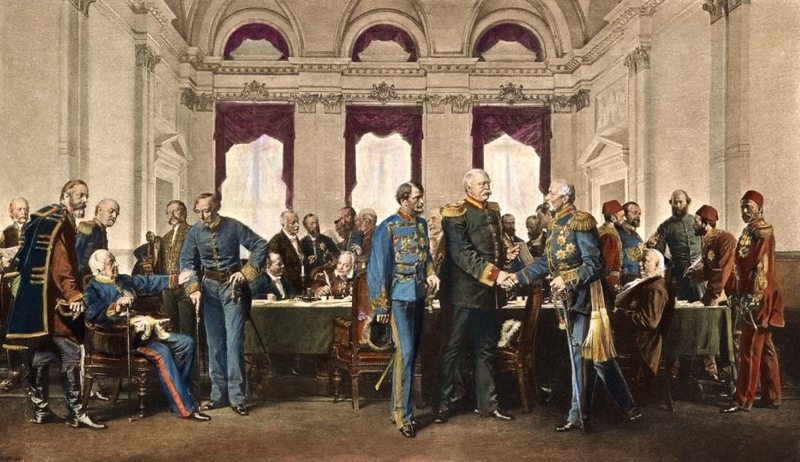
It was the great day when Montenegro – „that small country, hemmed in on all sides“, yet always fighting for freedom - received its final and official international recognition at the Congress of Berlin.
Even today, many mistakenly repeat the cliché that Montenegro gained its independence at the Congress of Berlin. It did not. Montenegro has never received anything as a gift throughout its history. Every one of its great achievements was paid for with the blood of its heroes.
Those who refused to be chained for a thousand years.
The same is true of the independence internationally recognised on 13 July 1878. It came only after the Great War, after the decisive battles of Vučji Do and Fundina, when the Montenegrins succeeded in driving the Ottoman army out of Nikšić, Bar, Ulcinj, and other towns. At the cost of immense sacrifice, more than 3,000 dead and over 7,000 wounded, Montenegro finally defeated the army of the Ottoman Empire.
And it secured its greatest victory of all: it remained what it had always been - a free country of free people. That is why 13 July deserves to be celebrated as Montenegro's greatest national day - because of 13 July 1878, and because of 13 July 1941.
The only question is whether, on 13 July 2026, today's Montenegro is truly aware of the historical legacy it has inherited.
MANDIĆ'S HISTORICAL REVISIONISM
If you listen to Andrija Mandić, you might conclude, at first glance, that he has finally acknowledged the existence of the 13 July Uprising.
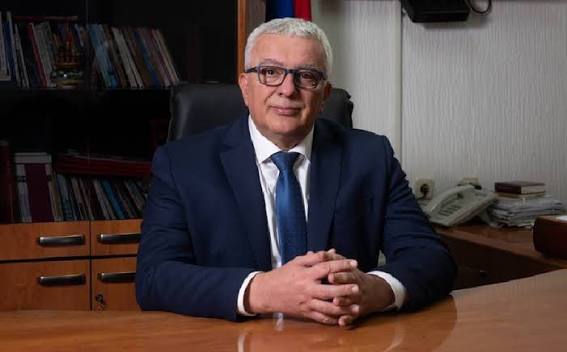
At first glance, one might even think that his role as Speaker of the Montenegrin Parliament has overshadowed the title of Chetnik commander, which Mandić received somewhere on Romanija Mountain in the mid-1990s.
But that impression lasts only at first glance. A careful reading of Mandić's Independence Day message reveals something that is not merely less clear, but considerably more disturbing.
For behind the façade of professed anti-fascism lies Mandić's crude and socially dangerous historical revisionism, coupled with denialism - the deliberate denial, minimisation or distortion of evidence relating to historical crimes.
Thus Mandić lectures the public that the Chetniks - as officers loyal to King Peter's army - were all, by definition, anti-fascists. He then argues that the Communists were not the driving force behind the uprising. Going even further, the Speaker of Parliament claims that „our grandfathers and grandmothers were motivated to rise up not by reading Karl Marx and Friedrich Engels, but by reading and following the legacy of Petar II Petrović Njegoš and Saint Peter of Cetinje“.
In Mandić's revisionist version of history, there were no preparations by the Communist Party for the uprising, no decision adopted at Ravni Laz in Piperi, no proclamation by the Communist Party of Yugoslavia's Committee for Montenegro, the Bay of Kotor and Sandžak announcing that the uprising would begin on 13 July.
THE ORIGINAL FALSIFICATION
Mandić's narrative bears no resemblance to history. It is not a historical interpretation - it is a textbook falsification.
It is often said that when people speak about others, they reveal themselves. The same applies to Andrija Mandić. When he speaks about 13 July, he says more about himself and the politics of his party than about history.
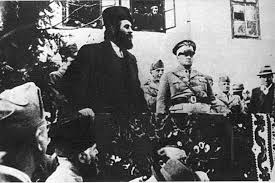
It becomes increasingly clear what the so-called new Serbian answer for a new era actually represents. Mandić's revision of history is an attempt to place, through a blitzkrieg of historical falsification, the Communists, who led the anti-fascist resistance, and the Chetniks on the same moral footing, despite the fact that the principal Chetnik commander in Montenegro, Pavle Đurišić, became one of the closest collaborators of Pirzio Biroli and the Italian fascist occupation authorities.
He also devoted himself - with ruthless brutality - to implementing Moljević's vision of a Homogeneous Greater Serbia. In pursuit of that objective, he left behind a horrific criminal legacy: In a report to General Draža Mihailović, Mandić's anti-fascist, Pavle Đurišić, stated that during January and February 1943 his Chetnik units had killed 1,200 adult Muslim men and slaughtered 8,000 women, children and elderly people in the districts of Pljevlja, Čajniče and Foča. Their only „crime“ was that they were Muslims.
When Mandić speaks of Chetnik anti-fascism, he knows he is repeating historical falsehoods. But those falsehoods serve a clear political purpose - to present himself to the bureaucracy in Brussels as a European politician while simultaneously remaining, in the eyes of many Serbs in Montenegro, their authentic representative and protector.
That, in essence, is Mandić's new Serbian answer for a new era.
PLAYING GAMES WITH EUROPE
In reality, it is merely a new tactic for pursuing the very same political agenda.
That is why the New Serbian Democracy (NSD) once quietly accepted the adoption of the Resolution on the Genocide in Srebrenica in the Parliament of Montenegro, only for Mandić and his associates later to block the adoption of the Day of Remembrance, as envisaged in Article 5 of that very Resolution.
That is also why three shameless pawns of the so-called Serbian World, appointed to the governing board of the Public Libary in Podgorica, voted to remove the name of Radosav Ljumović - a poet, revolutionary, veteran of the Spanish Civil War and a Communist - from the institution. For one reason alone - because he was a Communist and an anti-fascist.
And that is why Mandić's political ally Dario Vraneš in Pljevlja, together with other proponents of the Serbian World project across Montenegro, openly mock the symbols of Montenegrin statehood - without fear of prosecution or meaningful public condemnation. They hoist whatever flags they choose on the flagpoles of state institutions, while at the same time drawing salaries from the budget of the very Montenegro that now stands on the threshold of European Union membership.
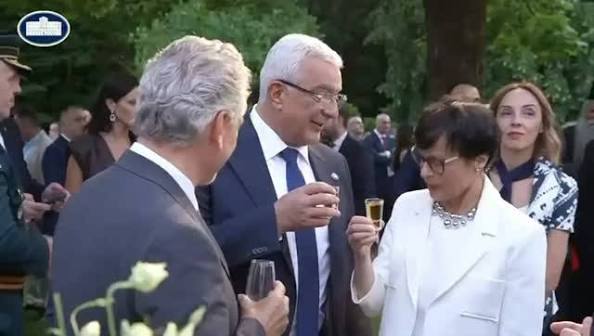
And when things go too far, Andrija Mandić steps onto the stage once again, ready to play the political game, to dance with Marta Kos, the European Commissioner for Enlargement; to clink glasses or down a shot of homemade plum brandy in one gulp, all in the name of Europe and Montenegro's European future.
But what kind of Montenegro is expected to join the European Union? That, it seems, concerns the bureaucrats in Brussels far less than it should, nor does it appear to trouble Montenegro's current governing majority, whose priority is to - remain in power.
Happy 13 July - not to everyone, but only to those who understand and cherish the values that this day represents.